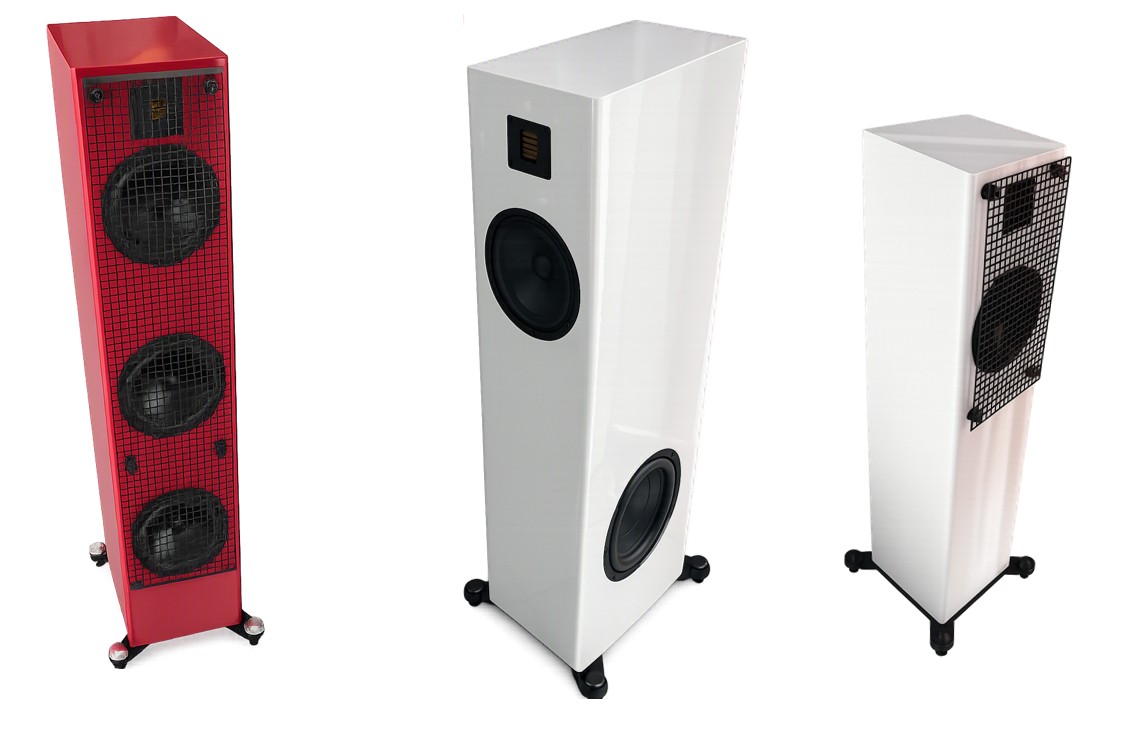
Discover the technical advantages of our loudspeaker series.
At first glance, measurement results may seem somewhat dull, yet they reveal a great deal about the quality and significance of a product or process. It is precisely through carefully recorded measurement data that important conclusions can be drawn—conclusions that are ultimately crucial for evaluation and improvement.
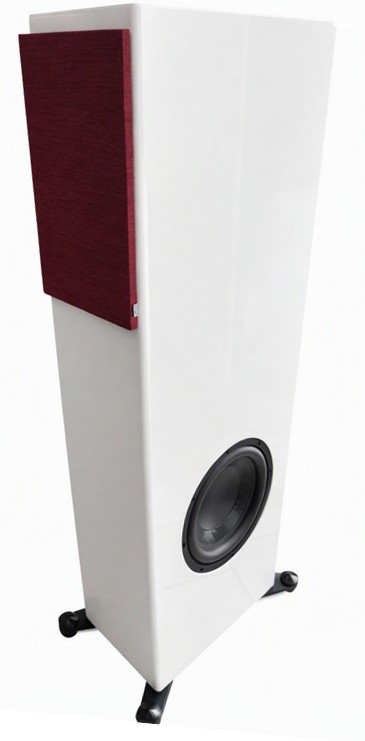
Choose the finish of your speaker from the PAL color palette
matt or high gloss
Fortissimo Grande, the top model
high-gloss white- (contact us for other finishes)
Fortissimo Grande
our current top-of-the-line model
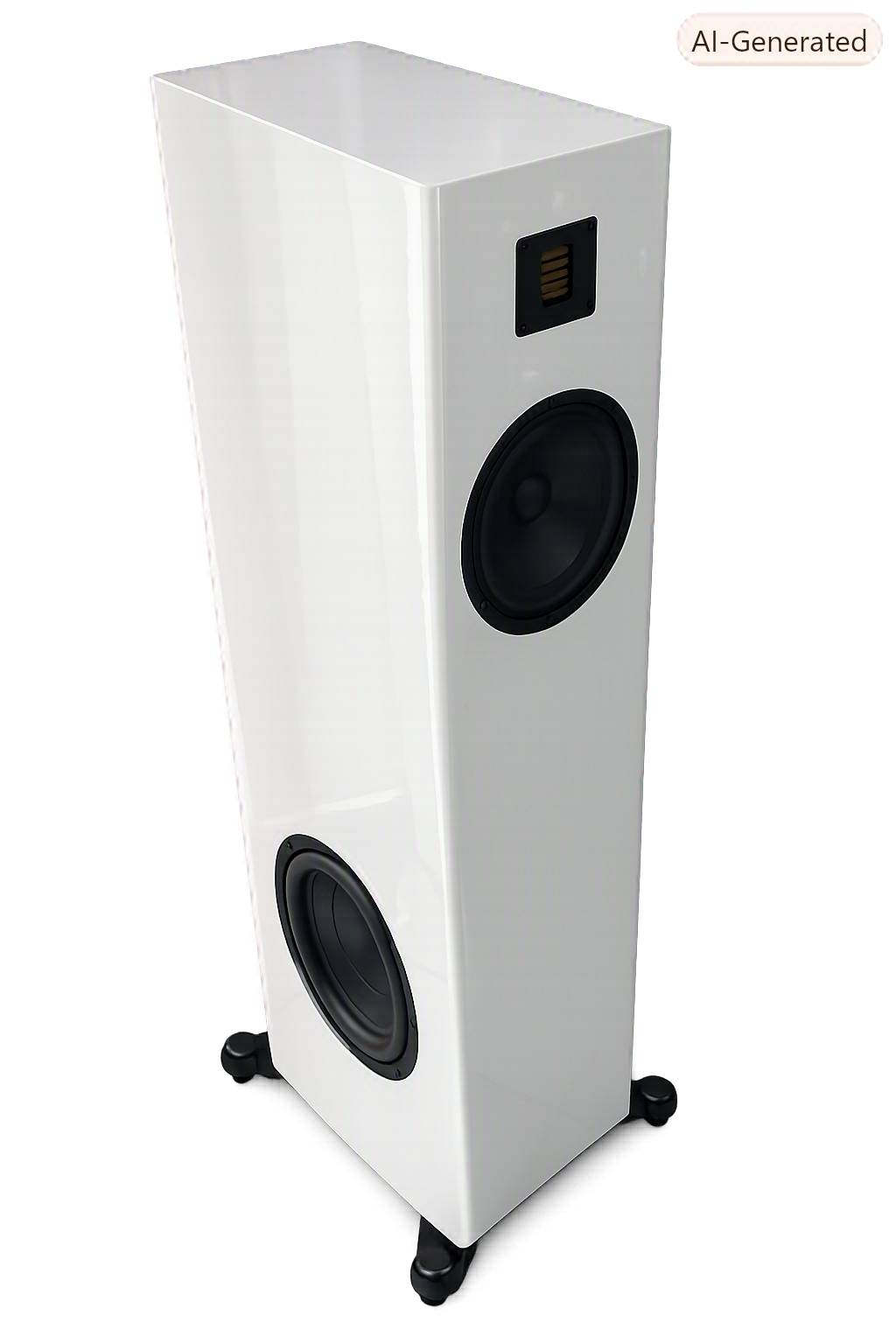
Air Motion Transformer (AMT) Tweeter
fast, high-resolution, and at the cutting edge of technology
Mid-bass driver with paper cone
lightweight, low-resonance, gentle roll-off
Subwoofer unit
long excursion, operating from 20 Hz and also equipped with a paper cone—though in this case, a coated version is used
low weight cone
very low resonances
Frequency response and phase response without FIR Filter
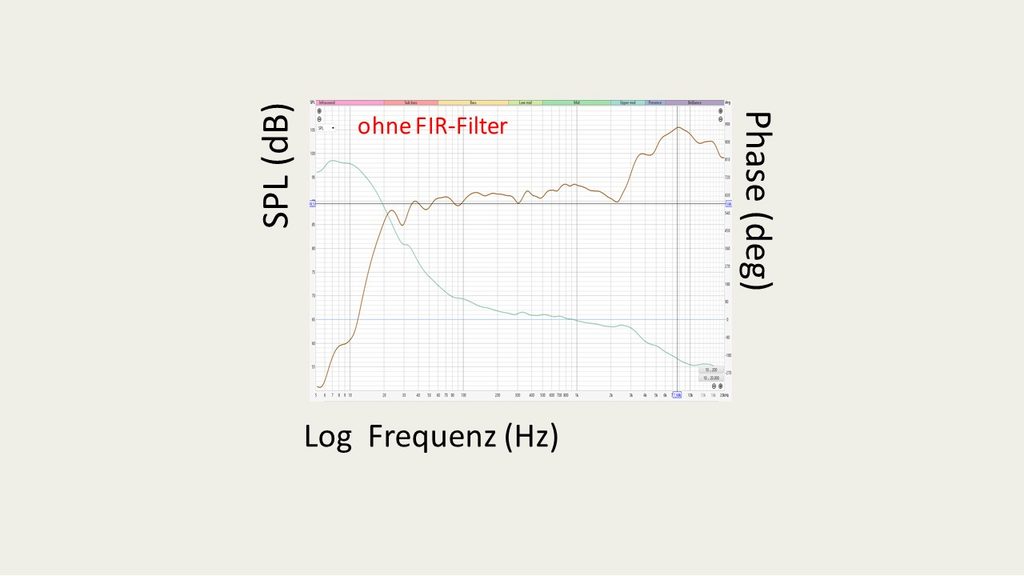
The frequency response extends from 20 Hz up to over 20 kHz, but requires FIR filter correction to reduce the AMT's amplitude peak.
While the phase response without FIR support is quite constant and rolls off gently but it spans more than three complete phase cycles — a total shift of over 1,000 degrees , which is to much
Frequency response and phase response with FIR Filter
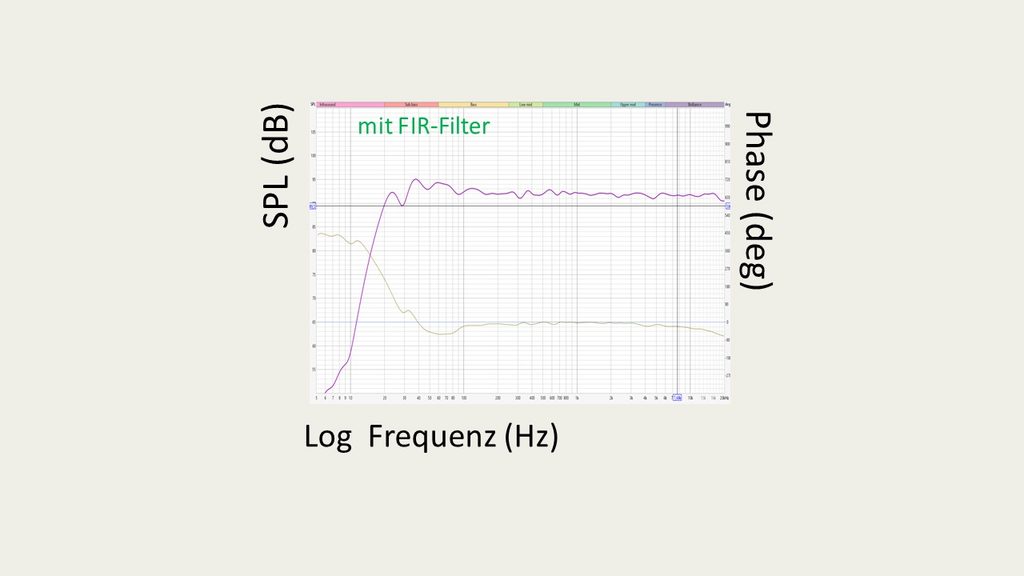
With FIR filter correction, the frequency response is significantly smoothed; it fluctuates by approximately +/- 1 dB above 100 Hz only. The range extends from 15 Hz to over 20 kHz. The AMT's amplitude peak has been completely "smoothed".
The phase response with FIR filter support is now absolutely constant, remaining at 0° from 100 Hz upwards.
Impulse response and time coherence without FIR Filter
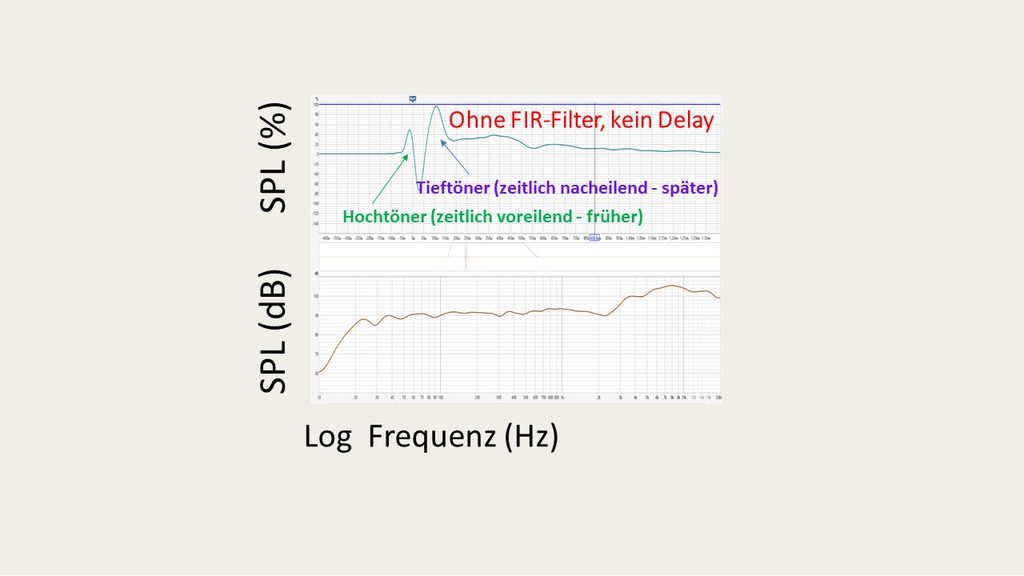
Without an FIR filter and appropriate signal delay for the AMT, the tweeter and woofer fall out of time alignment (top illustration). The bottom figure shows the frequency response corresponding to this setting.
Impulse response and time coherence with FIR Filter
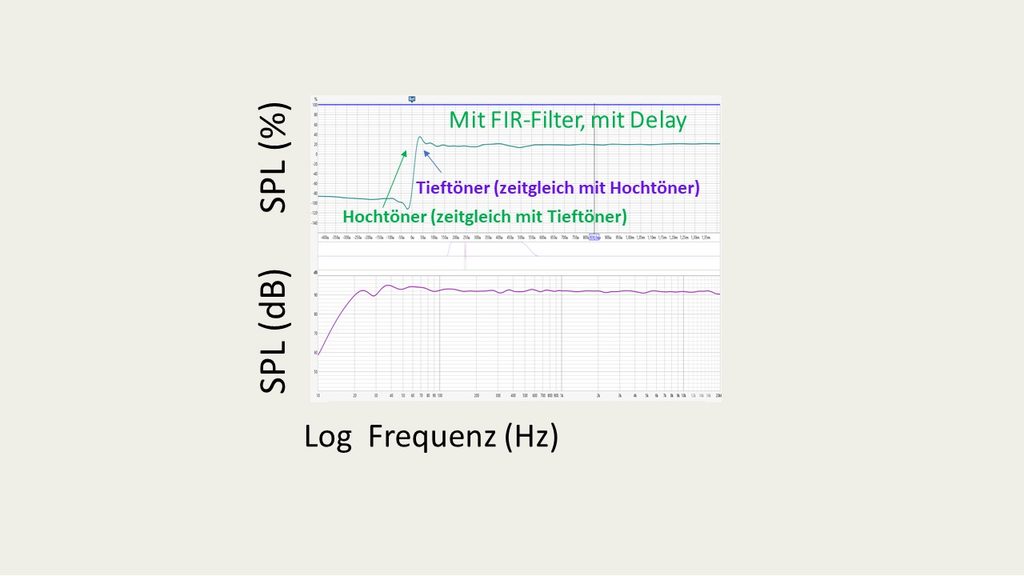
With an FIR filter and appropriate signal delay for the AMT, the impulse responses of the tweeter and woofer are time-aligned, just as they should be (top graph). The bottom graph shows the frequency response corresponding to this setting.
Total Harmonic Distortion (THD) without FIR Filter
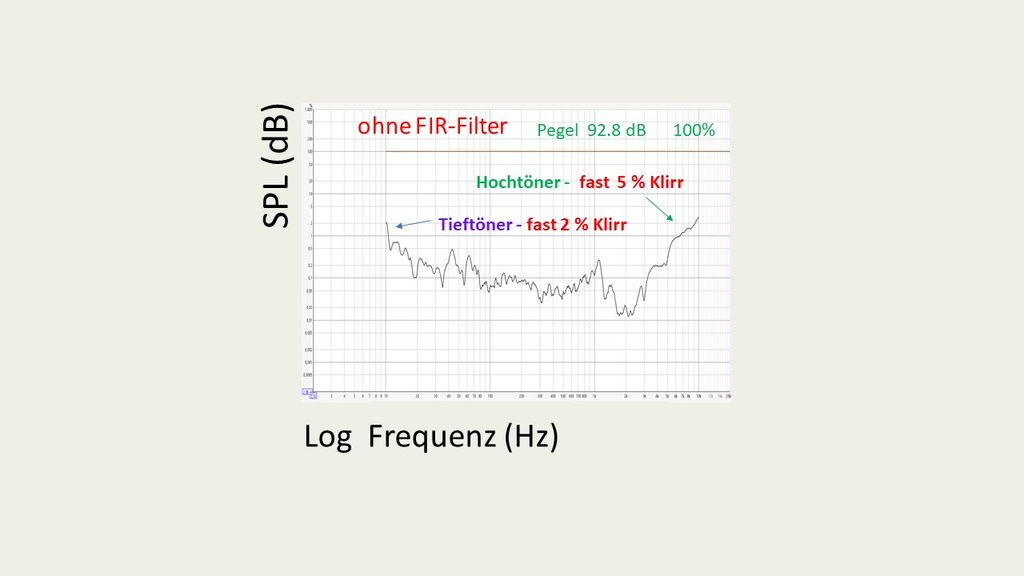
Without FIR corrections, harmonic distortion in the bass range reaches approximately 2%, while the tweeter reaches 5%, based on a total level of just under 93 dB (100%).
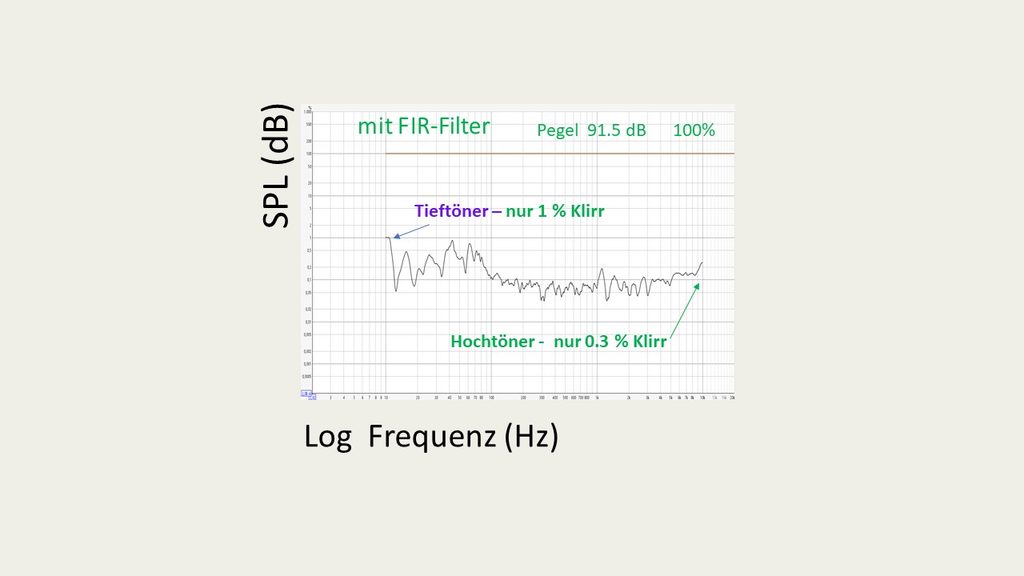
Total Harmonic Distortion (THD) with FIR Filter